
Managing a property requires keeping up with a never-ending list of maintenance tasks. From structural updates to cosmetic improvements, the work never truly stops. However, amidst all the responsibilities of maintaining a building, nothing is more critical than ensuring the safety of your gas infrastructure. For landlords and property managers across the capital, securing a gas safety certificate is not just an item on a annual to-do list—it is a foundational legal pillar that keeps residents safe, keeps businesses compliant, and provides absolute peace of mind.
Whether you operate a sprawling portfolio of rental units or you are a private resident caring for your family home, understanding how gas compliance operates in the UK is vital. This comprehensive guide breaks down everything you need to know about safety checks, legal mandates, regional cost expectations, and what happens behind the scenes during a professional inspection.
What Exactly is a CP12 Certificat e?
e?
To understand why this document holds so much weight, we have to look at its origin. Historically, the standard domestic gas inspection form was issued by the Council for Registered Gas Installers (CORGI) under the title “CORGI Proforma 12.” While the governing registry transitioned to the Gas Safe Register years ago, the shorthand terminology stuck around. Today, a is the formal document issued by a registered engineer to certify that all gas-burning appliances, internal pipework, and exhaust flues within a specific property have been thoroughly tested and verified as safe to use.
Think of it as a clean bill of health for your property’s gas network. The inspection evaluates how cleanly fuel burns, how securely your pipework holds pressure, and how efficiently your ventilation systems extract hazardous exhaust fumes from living spaces. If any part of the system shows signs of wear, degradation, or structural instability, the final paperwork will clearly note the defect alongside a directive on how to rectify it.
Do You Legally Need an Annual Gas Safety Check?
The legal obligations surrounding gas safety are very clear-cut, splitting property owners into two distinct categories based on occupancy type.
1. The Strict Legal Framework for Landlords
If you let out a residential property in England, Scotland, or Wales, holding a valid gas safety certificate is an unavoidable legal obligation under the Gas Safety (Installation and Use) Regulations 1998. The law states that landlords must ensure all gas appliances, fittings, chimneys, and flues provided for tenants are checked by a licensed professional every 12 months.
This rule applies universally across the private rental sector, social housing, and short-term holiday lets. Furthermore, if you employ a letting agency or property management firm to oversee your tenancies, they are legally barred from moving a new tenant into a property until you have handed over a copy of the current record. Landlords are also required by law to provide existing tenants with a copy of the renewed paperwork within 28 days of the physical inspection being completed.
The consequences of ignoring these regulations are severe and strictly enforced by the Health and Safety Executive (HSE):
Substantial Compliance Fines: Landlords found in breach of the 1998 regulations can face standard fines up to £6,000 per individual violation.
Insurance Invalidation: Operating without valid property safety certificates completely voids your landlord insurance policies, leaving you personally liable for any structural property damage or third-party injury claims.
Imprisonment & Criminal Liability: Severe or repeated non-compliance can result in custodial sentences of up to six months. In tragic cases where an unchecked appliance leads to a fatality from a fire or carbon monoxide poisoning, the responsible landlord can be prosecuted for gross negligence manslaughter.
2. The Recommendation for Private Homeowners
If you own the home you live in, you are not legally obligated to hold a CP12 Certificate UK. The law assumes that private residents will manage their own safety risks. However, omitting an annual inspection is a dangerous gamble.
Gas networks degrade silently over time. Vibrations from nearby traffic, standard home settling, and internal moisture can weaken joints, crack seals, and compromise boiler heat exchangers. Booking a proactive gas safety check every year ensures that your heating infrastructure remains reliable, runs efficiently, and poses zero health risks to your family. Furthermore, having a historical paper trail of professional maintenance is a massive advantage when selling your house, as prospective buyers routinely ask for recent service records during the conveyancing phase.
Step-by-Step: What Happens During the Inspection?
A professional gas inspection is not a brief visual glance over your kitchen appliances; it is a meticulous technical process. When a Gas Safe registered engineer arrives at your property, they follow a standardized sequence of engineering tests designed to stress-test your system’s integrity.
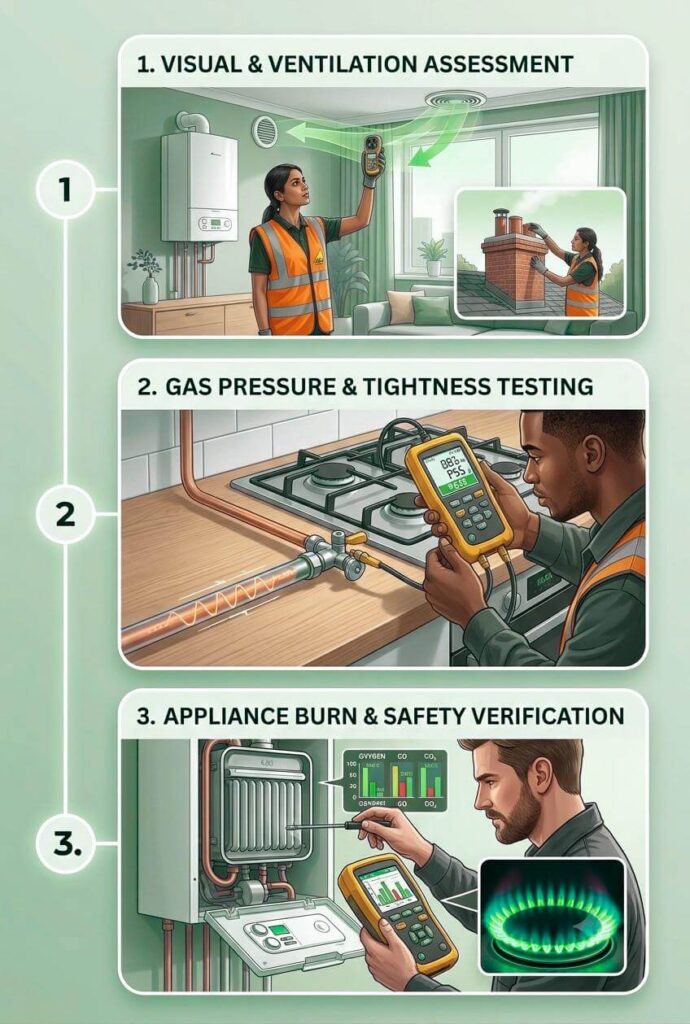
First, the engineer establishes the baseline by reviewing the gas meter and testing the overall infrastructure for structural drop-pressures. This allows them to instantly identify if gas is escaping somewhere behind your walls or beneath your floorboards. Next, they move from room to room, evaluating every single appliance that burns fuel, including boilers, cookers, hobs, and standalone fireplaces.
They will carefully inspect the exhaust paths. For boilers and wall heaters, this means verifying that the flues are securely connected and completely clear of external blockages like bird nests or fallen leaves. Engineers frequently use specialized smoke pellets to track the exact airflow path; if any smoke spills back into the living space, it indicates a blocked flue that requires immediate clearing before the system can be safely operated.
Finally, the engineer analyzes the burn quality. By checking the flame color and utilizing digital gas analyzers, they ensure that your appliances are receiving enough oxygen to burn fuel cleanly. A crisp blue flame indicates efficient combustion, whereas a lazy yellow or orange flame indicates incomplete combustion—the prime warning sign of deadly carbon monoxide production.
Decoding Inspection Failure Codes: What Happens If You Fail?
If an engineer identifies an issue that violates safety standards, they will mark the relevant appliance as “Not Safe to Use.” The engineer will then categorize the failure using one of three industry-standard warning codes:
Not to Current Standard (NCS): This means the appliance or installation is fundamentally safe but doesn’t meet the absolute latest building and installation codes. Because safety standards evolve over time, older installations frequently fall into this category. You are not forced to turn the system off, but the engineer will advise you on how to modernize the setup to improve its longevity and efficiency.
At Risk (AR): This code is applied when an engineer finds one or more distinct faults that could pose a danger to life or property if left unaddressed. If an installation is labeled AR, the engineer will ask for your permission to turn off the appliance and isolate its gas supply. It must remain turned off until a certified professional carries out the necessary repairs.
Immediately Dangerous (ID): This is the most critical classification. An ID code means that if the appliance is left connected to your gas supply, it poses an immediate, life-threatening danger to anyone inside the building. With your permission, the engineer will immediately disconnect the device. If a property owner refuses to grant permission for disconnection, the engineer is legally bound to report the situation to the national Gas Emergency Service Provider (ESP). The ESP has statutory powers to force entry into the premises to cut off the main gas supply for the protection of the wider public.
Navigating the London Market: Pricing and Logistics
When scheduling property compliance services, your location plays a major role in logistics and cost. Securing a gas safety certificate london involves navigating a uniquely dense property market. London engineers face distinct operational hurdles, including strict parking restrictions, daily congestion charges, ultra-low emission zone (ULEZ) fees, and the physical challenge of moving heavy diagnostic equipment through high-rise apartment complexes or older converted townhouses.
Because of these regional variables, pricing is not fixed nationally. Instead, rates scale based on your location and the exact number of appliances that require testing. For instance, a basic flat with a single gas boiler will cost noticeably less to certify than a large multi-story suburban home featuring a boiler, a kitchen hob, a separate gas cooker, and multiple living room fireplaces.
| Number of Appliances to Check | Average UK National Cost | Average London & M25 Cost |
| Gas Meter + 1 Appliance (e.g., Boiler only) | £60 – £80 | £75 – £95 |
| Gas Meter + 2 Appliances (e.g., Boiler & Hob) | £70 – £90 | £85 – £110 |
| Gas Meter + 3 Appliances (e.g., Boiler, Hob, & Fire) | £80 – £105 | £100 – £125 |
| Combined CP12 + Full Annual Boiler Service | £100 – £150 | £120 – £170 |
To maximize your budget, property experts recommend bundling your compliance checks. Combining your mandatory annual safety inspection with your standard boiler service during the same appointment can save you substantial amounts in call-out fees compared to booking them as two independent visits.
The Core Benefits of Hiring a Registered Professional
While the legal penalties are often the driving force behind booking an inspection, the practical benefits of holding updated documentation extend far beyond avoiding fines.
Protecting Against Carbon Monoxide
Carbon monoxide ($CO$) is a colorless, odorless, and tasteless gas, making it completely undetectable by human senses. It is produced when gas appliances burn fuel inefficiently due to blockages, poor ventilation, or faulty parts. An annual safety check utilizes digital diagnostic tools that catch trace amounts of $CO$ emissions long before they reach dangerous levels, protecting your tenants or family members from accidental poisoning.
Preventing Sudden Breakdown Expenses
Small mechanical issues rarely stay small. A minor pressure imbalance or a slightly restricted ventilation route forces your heating systems to work twice as hard to maintain your property’s ambient temperature. By identifying these structural discrepancies early during an inspection, you can address minor repairs on the spot, preventing complete system breakdowns during the coldest weeks of winter when emergency engineer rates are at their peak.
Smooth Real Estate Transactions
If you ever decide to place your property on the market, having an organized file of property safety certificates streamlines the legal process. Savvy buyers, mortgage lenders, and conveyancing solicitors will look over your gas records to confirm that the building has been well-maintained and doesn’t contain hidden utility liabilities. Having an active certificate prevents unnecessary transaction delays and protects your asking price.
How to Find a Trustworthy Gas Safe Engineer
You should never let someone work on your property’s gas lines unless they are officially registered. A regular handyman, plumber, or uncertified technician cannot legally conduct a compliance inspection or issue an official CP12 record.
When an engineer arrives at your doorstep, always ask to see their physical Gas Safe ID card. Take a moment to look at the back of the card as well—it lists the specific types of gas work they are certified to handle, as some engineers are qualified for domestic cookers but restricted from working on complex commercial boilers.
Finding a reliable provider shouldn’t be a source of stress. Our specialized platform simplifies property compliance by connecting you directly with vetted, fully insured, and highly rated Gas Safe registered professionals across London and the M25 area. By booking through our centralized marketplace, you avoid unexpected hidden fees, gain access to transparent pricing tables, and receive your verified digital certificates directly in your email inbox the moment the inspection concludes. Keep your home protected, remain fully compliant with UK law, and secure your property’s safety by organizing your annual check today.
Related Services
You can read more about the Gas Boiler Service.